נֹחַ - Noach - Rest - Tikkun Brit Hadshah and Tikkun Hisgalus
NOACH WAS A RIGHTEOUS MAN(NOACH ISH TZADDIK)
Shabbat,November 2,2024-( 1 Cheshvan 5785.)
NOACH ISH TZADDIK TAMIM HAYAH BEDOROTAV—"NOACH WAS A RIGHTEOUS MAN, PERFECT IN HIS GENERATIONS"
THE DAYS OF NOAH - TIKKUN BRIT HADSHAH AND TIKKUN HISGALUS
The Jewish sages understand these prohibitions as essential principles not only for Israel but also as part of the universal moral code. They connect them to the Noahide laws—commandments given to all humanity before the giving of the Torah to Israel. The sages emphasize that while Torah observance is a covenantal duty of Israel, these universal ethical principles are binding on all people. This makes Gevurot (Acts 15 & 21) from Tikkun Brit Hadshah significant in showing how the early followers of Jewish Pharisee Chassidut Yeshua HaTzaddik (Yeshua the Righteous) aligned Gentile conduct with the Noahide framework.
These sins are criticized as causes for Israel's exile and serve as a reminder of the ethical and ritual purity demanded by Torah. Eating with blood is seen by the sages as a severe breach because blood represents life, and consuming it is akin to disregarding the sanctity of life itself. Idolatry goes against the first of the Ten Commandments and is universally forbidden. Sexual immorality disrupts the family and community, leading to spiritual and societal decay.
In summary, Ezekiel 33:23-26 (Eating with blood, Idolatry ,Sexual immorality) and the Apostolic Council’s decrees in Acts share themes of ethical conduct and ritual purity essential for a life aligned with divine will. Both emphasize the importance of respecting life, maintaining purity, and avoiding actions that sever one from the divine source, which are core teachings within the Jewish sages’ framework for both Israel and the nations. These prohibitions encourage individuals to elevate their actions and intentions, thereby bringing themselves closer to God and contributing to the sanctification of the world.
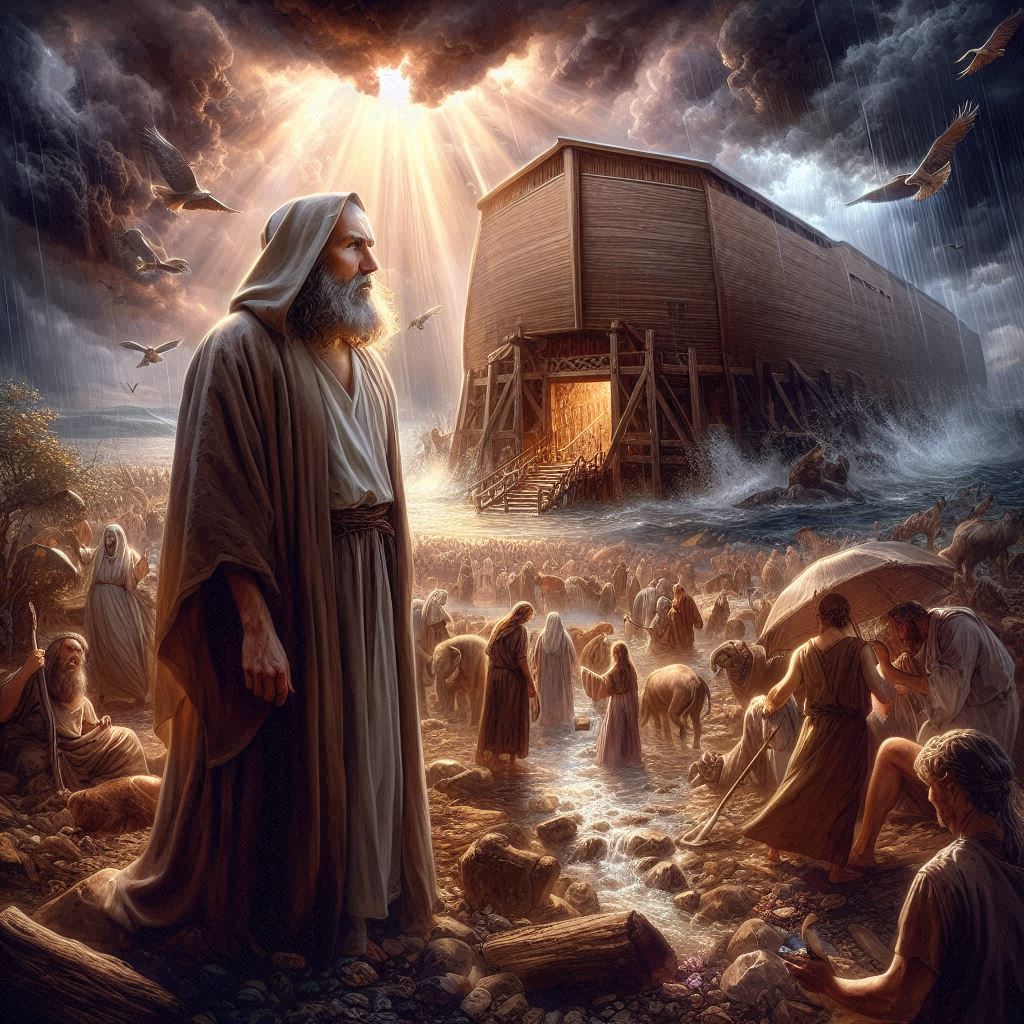
Signs and Reflection in "The Days of Noah":
The sages draw parallels between Noah’s generation and the "ikveta d’meshicha" (the footsteps of Mashiach), a time preceding redemption marked by upheaval and trial. The Sefer HaYashar, in particular, reflects on the need for spiritual vigilance as materialism and immortality increase, suggesting that such signs call for self-reflection and repentance.
Tikkun Hisgalus (Repair in Revelation):
Kabbalistic thought, particularly from Rabbi Isaac Luria (the Arizal), suggests that the flood prefigures the Tikkun Hisgalus—the cosmic repair necessary for divine revelation. Just as the flood "unveiled" a new reality for humanity, the end of days will bring a revelation that reshapes creation, fully unifying the divine and physical worlds.
Rabbi Yitzchak Ginsburgh elaborates on the idea that Mashiach will repair the “fallen sparks” that originated from the time of Noach. This tikkun process involves restoring balance between the spiritual and material, enabling a harmonious society where people fulfill their divine purpose, contrasting the chaos of Noach's time.
Signs of Redemption (Tikkun Hisgalus):
In Tikkunei Zohar (Tikkun 21), the sages discuss that the days before Mashiach’s arrival will mirror the spiritual confusion of Noach’s time. However, instead of leading to a literal flood, this period will lead to a “flood” of divine knowledge (Hisgalus) that fills the earth, ultimately lifting humanity out of ignorance and material obsession.
Technology as a Tool for Tikkun:
According to Rabbi Ginsburgh, the role of Mashiach ben Yosef parallels Noach's mission of preparing the ark, using technology and innovation for spiritual purposes. In the end of days, technology is seen as a vessel to spread divine knowledge and aid in global tikkun olam (repairing the world), countering the misuse of resources seen in Noach’s generation.
Flood as an Archetype of Transformation:
The sages in Midrash Tanchuma (Noach 5) explain that the flood symbolizes spiritual transformation. This archetype serves as a reminder that destruction is not the end but a precursor to a refined, elevated state that awaits humanity in the messianic era.
Role of the Tzaddik in Delivering Salvation:
Noach, described as a tzaddik (righteous person), serves as a model for Mashiach, who will guide humanity through a period of darkness into the light of redemption. This theme, as emphasized by the Baal Shem Tov, reflects the tzaddik’s unique role in guiding the world through times of crisis, illuminating the path to spiritual recovery and divine closeness.
But as the days of Noah were, so shall also the coming of the Son of man be. For as in the days that were before the flood they were eating and drinking, marrying and giving in marriage, until the day that Noach entered into the ark, And knew not until the flood came, and took them all away; so shall also the coming of the Son of man be. - Besorah al pi haDrash, Matti 24: 38, Brit Hadshah
THE GENERATION OF THE NOAH AND THE CORRUPTION OF THE END OF THE DAYS
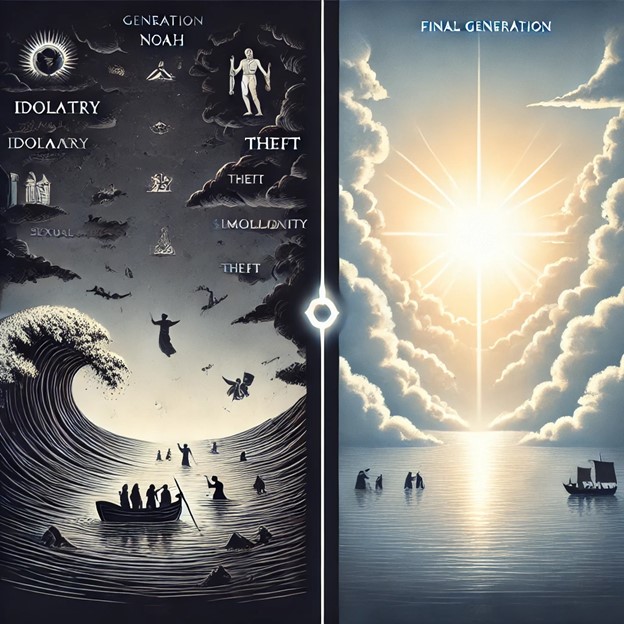
The connection between the generation of Noah and the corruption of the end of days, as mentioned in Besorah al pi haDrash, Matti 24:37 ("As it was in the days of Noah, so it will be at the coming of the Son of Man"), parallels Jewish traditions that reflect similar ideas of moral decay, divine judgment, and eventual redemption. Various Jewish texts, particularly from the Talmud, Midrash, and Kabbalistic writings, discuss the spiritual state of the generation of the flood (dor ha-mabul) and the sins that contributed to their destruction.
The rest of men, who were not killed in these plagues, neither did reform from the works of their hands, that they may not bow before the demons, and idols, those of gold, and those of silver, and those of brass, and those of stone, and those of wood, that are neither able to see, nor to hear, nor to walk,they did not reform from their murders, nor from their sorceries, nor from their whoredoms, nor from their thefts-Tikkun Hisgalus 9:21.Here we see the principal of midah knegged midah (measure for measure punishment). As men turned from G-d toward demons, G-d now turns these demons upon them.The idea “bowing down before demons and idols” does not necessitate a “primitive” act of worshiping a physical (i.e., “carved”) statue or anything similar. Involvement with anything “spiritual” that does not correspond to Torah, opens the door to the unleashing of demons as seen in this chapter.Yochanan mention of “gold,” “silver,’ “brass,” etc., has a mystical connection to the demonic “abyss/pit” (which is linked to gehenna or hell) itself. This pit is described as having seven levels to it. (Thus making this the “evil counterpart” to Beriah/Heaven, which is also said to have seven levels or “seven heavens” within it): … they are confined under the greatest concentration of laws in the Universe, constraining them from being too dangerous to themselves and to the Cosmos. Thus, they are imprisoned, we are told, in one of the Seven Palaces of Impurity while their impurities are melted, burnt and blasted away like metals under a process of elemental and chemical refinement. Indeed the symbology of the metallic and mineral realms is used to explain the qualities of Hell, with its sometimes slow and sometimes violent methods of extreme pressure, heat, cold and geological eons of time. This is another reason Hell is placed beneath the Malkut of Earth [Asiyah].
“A Kabbalsitic Universe,” Z’ev ben Shimon Halevi, Samuel Weiser, Inc., York Beach Maine, 1977, p.94.
The book of Enoch speaks of “mountains” of metals being brought down before the presence of G-d:
“And after those days in that place where I had seen all the visions of that which is hidden -for I had been carried off in a whirlwind and they had borne me towards the west-There mine eyes saw all the secret things of heaven that shall be, a mountain of iron, and a mountain of copper, and a mountain of silver, and a mountain of gold, and a mountain of soft metal, and a mountain of lead. And I asked the angel who went with me, saying, ‘What things are these which I have seen in secret?’ And he said unto me: ‘All these things which thou hast seen shall serve the dominion of His Anointed that he may be potent and mighty on the earth.’ And that angel of peace answered, saying unto me: ‘Wait a little, and there shall be revealed unto thee all the secret things which surround the Lord of Spirits. And these mountains which thine eyes have seen, The mountain of iron, and the mountain of copper, and the mountain of silver, And the mountain of gold, and the mountain of soft metal, and the mountain of lead, All these shall be in the presence of the Elect One As wax: before the fire, And like the water which streams down from above [upon those mountains], And they shall become powerless before his feet. And it shall come to pass in those days that none shall be saved, Either by gold or by silver, And none be able to escape. And there shall be no iron for war, Nor shall one clothe oneself with a breastplate. Bronze shall be of no service, And tin [shall be of no service and] shall not be esteemed, And lead shall not be desired. And all these things shall be [denied and] destroyed from the surface of the earth, When the Elect One shall appear before the face of the Lord of Spirits.”Enoch 52:1-9
The book of Enoch also offers the following views on this subject:
And He will imprison those angels, who have shown unrighteousness, in that burning valley which my grandfather Enoch had formerly shown to me in the west among the mountains of gold and silver and iron and soft metal and tin. And I saw that valley in which there was a great convulsion and a convulsion of the waters. And when all this took place, from that fiery molten metal and from the convulsion thereof in that place, there was produced a smell of sulphur, and it was connected with those waters, and that valley of the angels who had led astray (mankind) burned beneath that land. And through its valleys proceed streams of fire, where these angels are punished who had led astray those who dwell upon the earth.Enoch 67:4-7
And again I swear to you, ye sinners, that sin is prepared for a day of unceasing bloodshed. And they who worship stones, and grave images of gold and silver and wood (and stone) and clay, and those who worship impure spirits and demons, and all kinds of idols not according to knowledge, shall get no manner of help from them. And they shall become godless by reason of the folly of their hearts, And their eyes shall be blinded through the fear of their hearts And through visions in their dreams. Through these they shall become godless and fearful; For they shall have wrought all their work in a lie, And shall have worshiped a stone: Therefore in an instant shall they perish.Enoch 99:1-9
The Zohar speaks of the significance of metals in both worship of G-d and false worship:
“AND THE BRASS OF THE WAVING WAS SEVENTY TALENTS. Said R. Judah: ‘All this descends here below in the supernal image, containing the mystery of Faith. To the same pattern did Nebuchadnezzar make the image that he erected.’ R. Jose said: ‘It was not the image he made that was after the same pattern, but the image that he saw in his dream, an image made of gold, of silver and brass. Now, iron and clay were not worthy to enter into the work of the Tabernacle, but only those three metals. There is a recondite significance in the triad of metals. There were other materials that formed into tetrads, such as the four fabrics consisting of blue, purple, scarlet, and fine linen, or the four rows of stones (in the breastplate).’ R. Judah said: ‘Some of them formed into threes, some into fours, some into twos, and again others were kept single. Nevertheless, an Order proper consists of a triad.”Zohar, Shemoth 228a
"FIVE GRAVE SINS: INSIGHTS FROM THE JEWISH SAGES ON IDOLATRY, MURDER, SORCERY, SEXUAL IMMORALITY, AND THEFT"
The five sins of idolatry, murder, sorcery, sexual sin (whoredom), and theft are considered particularly severe in Jewish teachings. These sins are often mentioned together or in similar contexts within the writings of the sages as grave offenses that disrupt the moral fabric of society and violate the core commandments of the Torah. Here’s a breakdown of these sins according to the Jewish sages' writings:
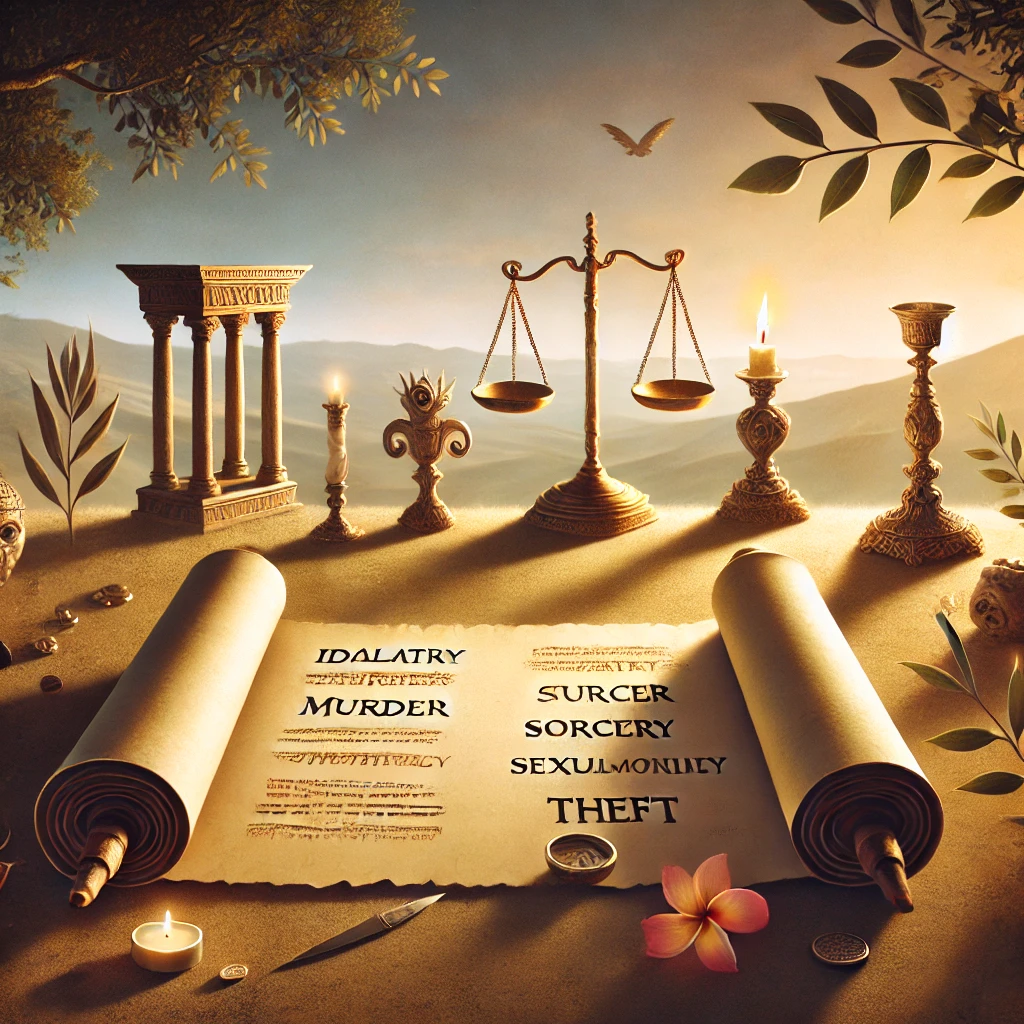
1.Idolatry (Avodah Zarah):
- Torah Source: Exodus 20:3 - "You shall have no other gods before Me."
- Talmud Bavli, Sanhedrin 61b: The Talmud discusses the severe consequences of idolatry, teaching that one who worships false gods commits an act of rebellion against the entirety of the Torah. This is viewed as the most grievous sin because it denies God's sovereignty and the central tenet of monotheism.
- Rambam (Maimonides) in Hilchot Avodah Zarah 2:1: Maimonides categorizes idolatry as one of the cardinal sins for which one must be willing to give up their life rather than transgress (alongside murder and sexual immorality).
2. Murder (Retzichah):
- Torah Source: Exodus 20:13- "You shall not murder."
- Mishnah, Sanhedrin 4:5: The Mishnah emphasizes the sanctity of human life, stating that anyone who destroys a single life is as though they destroyed an entire world. This highlights the gravity of murder in Jewish law and thought.
- Talmud Bavli, Sanhedrin 57a: It is taught that one of the Noahide laws (universal commandments for all humanity) is the prohibition against murder. It applies universally, and the punishment is severe in this world and the next.
3. Sorcery (Kishuf):
- Torah Source: Exodus 22:17 - "You shall not allow a sorceress to live."
- Talmud Bavli, Sanhedrin 67b: Sorcery is treated as a severe sin because it involves manipulating creation in a way that usurps divine authority, often associated with idolatry. The sages teach that sorcery deceives and leads people away from God by giving false appearances of power.
- Rambam, Hilchot Avodah Zarah 11:16: Maimonides explains that sorcery is forbidden not only because of its deceptive nature but also because it leads people to rely on other forces instead of trusting in God's providence.
4. Whoredom (Sexual Sin or Immorality, Gilui Arayot):
- Torah Source: Leviticus 18:6-30 - This section of the Torah provides a detailed prohibition against various illicit sexual relations, emphasizing the need for sexual purity.
- Talmud Bavli, Yoma 29a: Sexual immorality is considered one of the most severe sins, often leading to the destruction of societies. The sages equate sexual sin with idol worship because both sins involve a breach of loyalty—one to God, the other to one’s spouse and the sanctity of marriage.
- Rambam, Hilchot Teshuvah 4:1:Sexual immorality is one of the sins that particularly obstructs a person’s ability to repent because it causes deep spiritual damage and societal harm.
5. Theft (Gezel):
- Torah Source: Exodus 20:15 - "You shall not steal."
- Talmud Bavli, Sanhedrin 108a: The Talmud connects the sin of theft with the generation of the flood, teaching that widespread theft was the final sin that sealed their fate. Theft undermines the foundation of a just and moral society, where respect for others' property is essential.
- Mishnah, Pirkei Avot 5:10:The Mishnah teaches that theft, even of the smallest amount, is a sign of moral corruption and selfishness. The sages emphasize that theft leads to the breakdown of trust within society.
Collective Significance:
In Jewish thought, these five sins—idolatry, murder, sorcery, sexual sin, and theft—are considered some of the most severe because they represent direct violations of fundamental aspects of a moral society and a proper relationship with God:
- Idolatry violates loyalty to God.
- Murder destroys the sanctity of life.
- Sorcery usurps divine authority and leads to deception.
- Sexual immorality breaks the sanctity of relationships and purity.
- Theft undermines trust and justice in society.
These sins are often highlighted together in texts, such as Talmud Bavli, Avodah Zarah 17a, where they are mentioned as particularly grievous transgressions for which repentance is difficult and divine judgment severe. They are also among the sins mentioned in connection with the destruction of the Temple and the subsequent exiles of Israel, indicating their far-reaching consequences for both individuals and communities.
Conclusion:The Jewish sages emphasize the severity of these five sins as foundational to both spiritual integrity and societal stability. They disrupt the relationship between man and God, man and fellow man, and the moral structure of the world, necessitating strong deterrence and deep repentance.
TIKKUN BRIT HADSHAH-FIVE GRAVE SINS
These insights collectively paint a picture of the end of days as a time that mirrors the days of Noach, both in moral challenges and in the opportunity for profound spiritual transformation. Through Tikkun Brit Hadshah and Tikkun Hisgalus, we are reminded that while judgment may come as a form of correction, it ultimately serves as a pathway toward redemption and the revelation of the divine. The teachings of the sages thus encourage preparation through teshuvah, alignment with divine will, and a commitment to the spiritual tikkun of ourselves and our communities as we await the arrival of Mashiach.
Hisgalus 9:21-Orthodox Jewish Bible-21 And they did not make teshuva (repentance, turning from sin to G-d) of the retzichot (murders) of them nor of the kishufim (sorceries) of them nor of the zenunim (fornication) of them nor of the gneyvot (thefts) of them.
They did not reform from their murders, nor from their sorceries, nor from their whoredoms, nor from their thefts.
In these two verses, John associates five categories of sin with the plague of demons that was brought forth.They are:
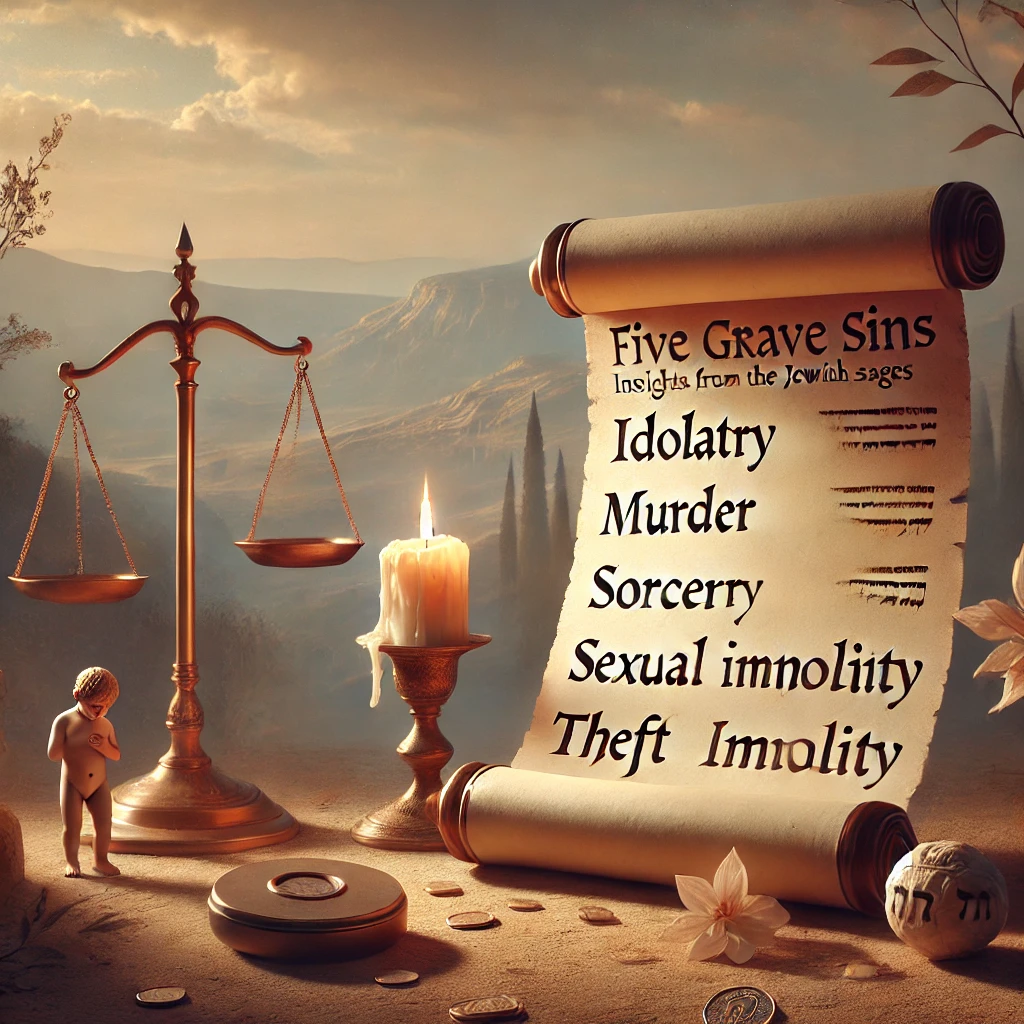
- Idolatry
- Murder
- Sorcery
- Whoredom (sexual sin)
- Theft
We will examine each of these sins with regard to their connection to the demonic realm. Attention will be given to the generation of the flood, as in Besorah al pi haDrash Matti 24:37 it is said that the last days would mirror the days of Noah.
These themes align with certain categories of sin mentioned in your query. Let’s explore these sins—idolatry, murder, sorcery, whoredom, and theft—through the lens of Jewish tradition, especially in relation to the generation of Noah and the end times.
The verse from Hisgalus (Revelation) 19:2 that states, "They did not reform from their murders, nor from their sorceries, nor from their whoredoms, nor from their thefts," resonates deeply with themes explored in Jewish mystical and ethical thought, particularly when viewed through the lens of Tikkun (spiritual rectification) and the writings of the sages.
Jewish Sages' Insights on the Need for Tikkun (Rectification) for the Same Sins:
The connection between this verse and the Tikkun Brit Hadasha (New Covenant in Hebrew), which is rooted in the concept of tikkun (rectification or repair), highlights the need for humanity to correct these specific sins. Each of these sins—murder, sorcery, sexual immorality, and theft—has profound implications in Jewish tradition, as the sages stress that these acts not only harm individuals but also disrupt the cosmic order.
1.Murder (Retzichah):
- The sages teach that murder is a sin that destroys life, the highest creation of God. In the Talmud, Sanhedrin 4:5, the Mishnah emphasizes that taking one life is like destroying an entire world. Murder represents the ultimate desecration of the divine image (Tzelem Elokim) in humanity, and rectification (tikkun) for this sin requires not only atonement but also a deep recognition of the sanctity of life.
- Tikkun for murder involves promoting life, peace (Shalom), and justice. The Zohar emphasizes that restoring the balance of the universe after the sin of murder involves repentance and actions that restore life and dignity.
2.Sorcery (Kishuf):
- Sorcery is considered a severe transgression because it attempts to manipulate the forces of creation, challenging the sovereignty of God. Rambam (Maimonides, Hilchot Avodah Zarah 11:16) teaches that sorcery leads people away from trusting in God’s providence, giving them a false sense of control over the divine order.
- In Kabbalistic terms, sorcery disrupts the flow of divine light from the higher worlds. Tikkun for this sin involves returning to pure faith in God’s providence and recognizing that only divine will governs the world. The path of tikkun calls for humility and submission to God’s higher wisdom, which aligns one with the true spiritual forces of creation.
3.Whoredom (Sexual Immorality, Gilui Arayot):
- Sexual immorality is described as a severe sin in the Torah because it defiles the sanctity of relationships and the covenant of marriage. The Midrash Tanchuma (Parashat Vayera 6) explains that immorality brings divine judgment upon a community, as it disrupts the purity and holiness of human relationships, which are meant to reflect God’s relationship with Israel.
- The Tikkun for sexual immorality involves Tikkun HaBrit (rectification of the covenant), which is often discussed in Chassidic and Kabbalistic teachings as the spiritual purification of one’s moral and physical desires. The Baal Shem Tov and later Chassidic masters taught that rectification involves engaging in modesty, purity, and the sanctification of personal relationships in line with divine laws.
4.Theft (Gezel):
- Theft, as taught by the sages, undermines the foundations of society. In the Talmud, Sanhedrin 108a, theft is noted as one of the primary sins that sealed the fate of the generation of the flood, showing its destructive impact on communal trust and justice.
- The rectification for theft involves Tzedakah (charity) and justice.The Kli Yakar teaches that giving back and restoring what has been wrongfully taken is a key element of tikkun for this sin. By upholding justice and fairness, one restores harmony between individuals and within society.
Tikkun for These Sins in Jewish Thought:
- According to Jewish mystical thought, these four sins—murder, sorcery, sexual immorality, and theft—are rooted in the imbalance of spiritual forces within the person and the world. Kabbalistic texts, such as the Zohar, explain that these sins result from the disruption of the balance between the divine attributes of Chesed (kindness) and Gevurah (severity). To achieve Tikkun, the individual and the community must align themselves with divine justice and mercy, allowing divine light to flow through the proper channels.
- Tikkun Olam (Repair of the World): The sages emphasize that repentance (teshuvah), charity (tzedakah), and righteous acts are critical to correcting these sins and restoring balance to the world. In Pirkei Avot 1:2, it is taught that the world stands on three pillars: Torah, service to God, and acts of kindness. When these foundational elements are upheld, the negative impact of these grave sins can be rectified, both spiritually and practically.
- Tikkun through Teshuvah (Repentance): The Jewish sages, particularly Rambam in Hilchot Teshuvah, stress that repentance is not merely an intellectual or emotional acknowledgment of wrong but a deep transformation that repairs the spiritual damage caused by sin. This idea is echoed in Isaiah 1:18: "Though your sins be as scarlet, they shall be as white as snow." This verse is often cited by the sages to illustrate the power of teshuvah to bring complete tikkun.
Conclusion:The verse in Hisgalus (Revelation) 19:2, describing the refusal to repent from sins such as murder, sorcery, sexual immorality, and theft, aligns deeply with Jewish teachings about the gravity of these transgressions and the necessity for Tikkun. According to the sages, these sins represent severe disruptions of the divine order, both on an individual and societal level. However, through sincere teshuvah, righteous deeds, and alignment with the divine will, the Jewish sages teach that true tikkun is possible, allowing for the restoration of harmony and spiritual elevation in both this world and the next.
THE GENERATION OF NOAH-VIEWED IN JEWISH TRADITION
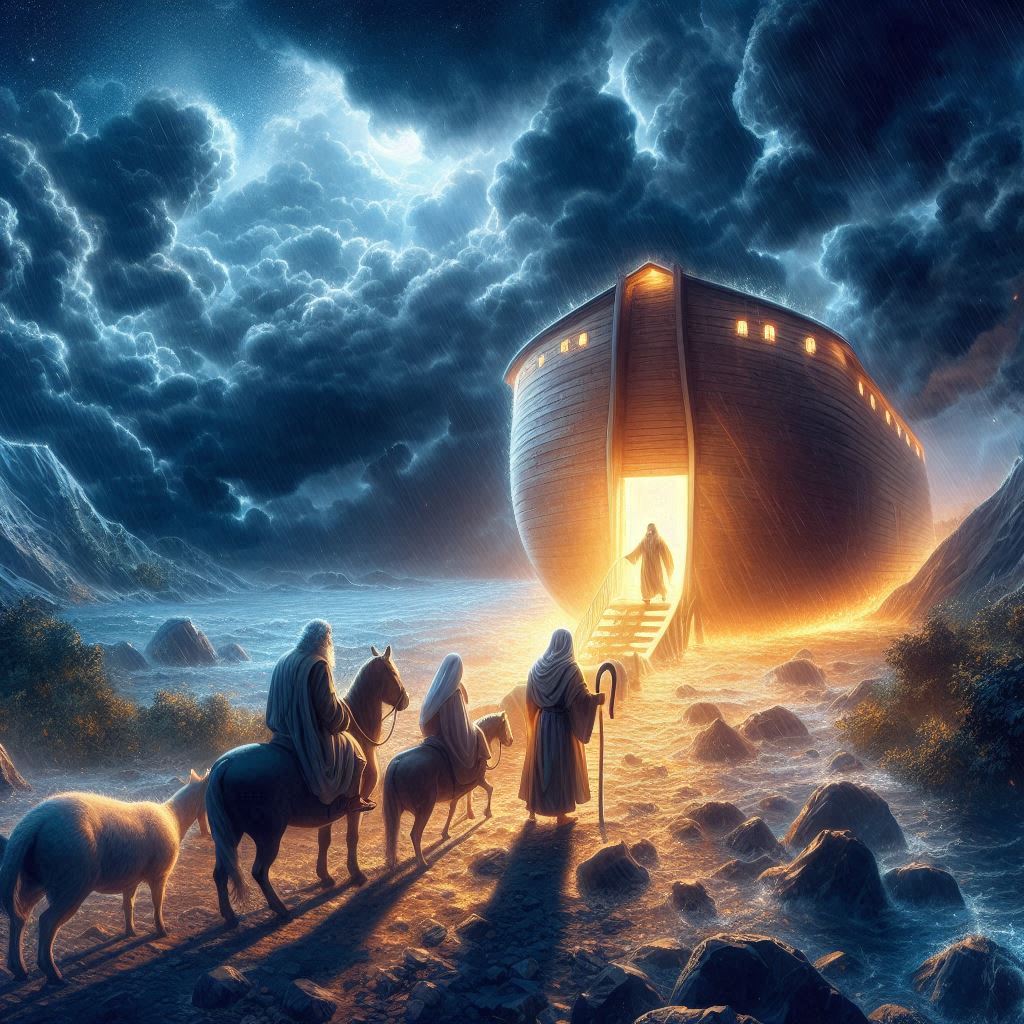
1. Idolatry
- Idolatry is a central theme in the Torah’s critique of ancient civilizations, especially the generation of Noah. In Jewish tradition, idolatry is more than just worshiping physical idols—it represents a rebellion against God’s sovereignty and an opening to spiritual impurity.
- The Talmud(Sanhedrin 57a) discusses how the generation of Noah was steeped in idolatry, which contributed to their moral downfall. According to the Midrash (Genesis Rabbah 26:5), the people in Noah’s time had reached such a level of moral and spiritual degradation that they even created new forms of idolatry, worshiping both celestial beings and human inventions.
- The Zohar emphasizes that idolatry connects people to the realm of demonic forces and impurity (kelipot), which bring destruction upon the world. In Noah’s time, idolatry corrupted not only their worship but their entire way of life, which ultimately invited divine judgment.
- At the time of the flood, mankind had sunk to its lowest in many ways. One of these concerned the “level of idolatry” they stooped to. Although all forms of idolatry are bad, when people go from worshipping the higher angels or men (which are “close” to G-d) to the lowest demons (which are “far” from G-d), this is considered a further indication of their decayed spiritual state.
- Rabbi Nachmanides had the following to say about this:“The third group of idol worshippers eventually served demons, a type of spirit, for also of them are appointed over nations to damage their enemies. Regarding this, the verse says (Deuteronomy 32:17): “They sacrificed to demons, which were not G-d: gods that they did not know; new ones recently concocted, whom your forefathers did not dread.” The verse makes fun of them; they sacrifice to demons, which are not Divine at all. They are not [even] like angels, or separate intelligences that are called Divine, but these are gods they never know, that is, they have no Divinity or power, they are newly thought up, in other words, they learned of them anew from the Egyptians, who engage in sorcery, and even your wicked forefathers such as Terach and Nimrod weren’t afraid of them.”
“Ramban, Philosopher and Kabbalist,” Chayim J. Henoch, Jason Aronson Inc., Jerusalem, 1998, pp. 198-199.” - In the Messianic era, similar corruptions in belief and spirituality are prophesied in Jewish texts, particularly in the Midrash Tanchuma (Noach 4), which warns that the generation before Mashiach will also return to forms of idolatry and spiritual perversion, inviting divine purification.
2. Murder
- Murder, or the devaluation of human life, is another major sin attributed to the generation of Noah.
- Genesis Rabbah (31:4) relates that the earth became "filled with violence" (Genesis 6:11), which is understood to mean widespread bloodshed and disregard for life. The Talmud (Sanhedrin 108a) links this directly to the decree of the flood, arguing that murder was a key factor in God's decision to destroy that generation.
- In the mystical tradition,murder is seen as a manifestation of the unbalanced force of Gevurah (Judgment), which, when not tempered by mercy, leads to destruction. According to Kabbalistic writings, the shedding of innocent blood brings impurity into the world, feeding the demonic realms and hastening divine retribution.
- Aside from the obvious transgression of unjustly taking a human life,there is another aspect of murder directly associated with the Sitra Achra (the evil realm). As demons both live and die, one may ask, “What sustains and empowers them?” It is well known that throughout history, people have sacrificed human beings to various spiritual entities in order to acquire benefit from them. Aside from “formal” sacrificial rites, the very act of murder (the “shedding of blood”) also empowers these beings.?
- We know from Scripture that blood contains the spiritual life force, therefore blood is very powerful. Kabbalistically, when people sin they impact the subtle balance between the physical and non-physical worlds. A sin causes “energy” to be used in the physical world in a spiritually improper manner. As energy is taken, it must be returned. Lucky for us, instead of taking our lives to restore this balance, G-d ordained animal sacrifice as a substitute.
- The ‘forces of the Sitra Achra’ also know that blood, especially human blood contains such “power.” Through the shedding of human blood, these forces acquire spiritual energy from the universe. As an example, looking back in history, people have wondered how the Nazis came to power and achieved such great technological advances so quickly. It is known that the Nazis had great interest in the occult and spent huge sums of money investigating such things. It could be that they were empowered by demons in exchange for all the blood they shed.
- In Jewish eschatology,the generation before the Mashiach is likewise described as being filled with violence and murder. The Talmud (Sotah 49b) prophesies that the pre-Messianic era will be characterized by a complete disregard for life, with widespread bloodshed and chaos, mirroring the world before the flood.
3.Sorcery
- Sorcery (kishuf) is closely related to demonic forces in Jewish mystical thought and was another sin associated with the generation of Noah.
- The Talmud (Sanhedrin 67b) discusses how sorcery draws on impure forces and spiritual corruption, aligning its practitioners with the demonic realms.
- The Midrash (Genesis Rabbah 26:5) describes how the generation of Noah engaged in various forms of sorcery, believing they could manipulate spiritual forces for their own benefit.
- According to Kabbalistic teachings, sorcery represents the exploitation of impure spiritual forces (the kelipot or shells of impurity). The generation of Noah believed they could control these forces, which ultimately contributed to their downfall. The Zohar emphasizes that sorcery weakens the divine energy that sustains creation and strengthens demonic entities, bringing the world closer to destruction.
- Sorcery involves “tapping into” the powers of what is beyond the purely physical realm, specifically the angelic world of Yetzirah, in a way not approved by G-d. There are numerous ways to do this, including; use of drugs, spiritual incantations, and “psychic powers.”
- This section of the Zohar explains how the ability to draw power from the world of Yetzirah (through magic/divination) caused the generation of the flood to think they did not need G-d and could fend off any judgment coming from Him:
- “R. Eleazar said: ‘In the time of Enosh, men were skilled in magic and divination, and in the art of controlling the heavenly forces. Adam had brought with him from the Garden of Eden the knowledge of “the leaves of the tree”, but he and his wife and their children did not practice it. When Enosh came, however, he saw the advantage of these arts and how the heavenly courses could be altered by them, and he and his contemporaries studied them and practiced magic and divination. From them these arts descended to the generation of the Flood and were practiced for evil purposes by all the men of that time. Relying upon these arts, they defied Noah, saying that divine justice could never be executed upon them, since they knew a way to avert it. The practice of these arts commenced with Enosh, and hence it is said of his time, THEN WAS THE NAME OF THE LORD CALLED UPON PROFANELY. R. Isaac said: All the righteous men that were among them sought to restrain them, such as Jered, Methuselah, and Enoch, but without success, and the world became full of sinners who rebelled against their Master saying, “What is the Almighty that we should serve him?” (Job 21:15). This is not so foolish as it sounds, for they knew all the arts we have mentioned and all the ruling chieftains in charge of the world, and on this knowledge they relied, until at length G-d disabused them by restoring the earth to its primitive state and covering it with water. Later, He again restored it and made it productive, since He looked upon it with mercy, as it is written, “The Lord sat at the Flood”-”the Lord” signifying the attribute of mercy. In the days of Enoch even children were acquainted with these mysterious arts.’ Said R. Yesa: ‘If so, how could they be so blind as not to know that G-d intended to bring the Flood upon them and destroy them?’ R. Isaac replied: ‘They did know, but they thought they were safe because they were acquainted with the angel in charge of fire and the angel in charge of water, and had means of preventing them from executing judgement on them. What they did not know was that G-d rules the world and that punishment proceeds from Him. They only saw that the world was entrusted to those chieftains and that everything was done through them, and therefore they took no heed of G-d and His works until the time came for the earth to be destroyed and the Holy Spirit proclaimed every day, “Let sinners be consumed out of the earth and let the wicked be no more” (Psalm 104:35). G-d gave them a respite all the time that the righteous men Jered, Methuselah, and Enoch were alive; but when they departed from the world, G-d let punishment descend upon them and they perished, as it says, “and they were blotted out from the earth” (Genesis 7:23).”Zohar, Bereshith 56a
- In the Messianic era,it is said that sorcery and reliance on dark spiritual forces will resurface, as humanity turns away from divine truth. The Zohar and Midrashim predict a resurgence of occult practices and manipulations of spiritual forces as a sign of the imminent redemption.
4. Whoredom (Sexual Sin)
- The sexual corruption of the generation of Noah is one of the most discussed themes in Jewish texts.
- Genesis Rabbah (26:5) and the Talmud (Sanhedrin 57a) describe how sexual immorality was rampant in Noah’s time.
- The Midrash explains that the people engaged in unnatural sexual acts, including bestiality and widespread promiscuity. According to Jewish thought, this level of immorality not only corrupted human relationships but also the animal kingdom, as even the animals "became corrupted" (Genesis 6:12), possibly a reflection of spiritual contamination that spread throughout creation.
- The Zohar relates sexual sin to the demonic realm, explaining that acts of lust and promiscuity strengthen the impure forces in the world. According to Kabbalistic thought, sexual sin opens pathways to demonic control, allowing forces of impurity to grow stronger, which hastens divine judgment.
- Illicit sexual activity is associated through kabbalistic writings as actually “creating demons.” (Note how many Torah commands deal with sex, from adultery, to homosexuality, to incest to bestiality — and how these merit the death penalty.)
- The following passages from both Zohar, Midrash and Talmud discuss the sexual sins of Noah’s time:
- “There is no sin in the world which so much provokes the anger of the Almighty as the sin of neglecting the covenant, as we read, “a sword that shall execute the vengeance of the covenant” (Lev. XXVI, 25).The proof is that in the generation of the Flood the measure of sin was not filled up until mankind became (sexually) perverted and destroyed their seed.”Zohar, Bereshith 66b
- “The men of the generation of the Flood used to act thus: each took two wives, one for procreation and the other for sexual gratification. The former would stay like a widow through- out her life, while the latter was given to drink a potion of roots, so that she should not bear, and then she sat before him like a harlot, as it is written, He devoureth the barren that beareth not, and doeth not good to the widow (Job XXlV, 21). The proof of this is that the best of them, who was Lamech, took two wives, Adah, [so called] because he kept her away (ya’ade) from himself; and Zillah, to sit in his shadow (zillo).” Midrash Rabbah, Genesis 23:3
- Hence it is written, For they were fair, which refers to virgins;And they took them wives, refers to married women, Whomsoever they chose: that means males and beasts. R. Huna said in R, Joseph’s name: The generation of the Flood were not blotted out from the world until they composed nuptial songs in honour of pederasty and bestiality. R. Simlai said: Wherever you find lust, an epidemic visits the world which slays both good and bad.” Midrash Rabbah, Genesis 26:5
- “For all flesh had corrupted his way upon the earth. R. Johanan said: This teaches that they caused beasts and animals, animals and beasts, to copulate; and all of these were brought in connection with man, and man with them all.” Talmud, Sanhedrin 108a
- “The Generation of the Flood were blotted out from the world because they were steeped in whoredom. R. Samlai observed: In every instance where you find the prevalence of whoredom, an androlepsia1 comes upon the world and slays both good and bad. R. Huna says in the name of R. Jose: The Generation of the Flood were only blotted out of the world on account of their having written hymenean songs for sodomy. R. ‘Azariah in the name of R. Judah son of R. Simeon and R. Joshua b. Levi in the name of Bar Kappara say: We find that the Holy One, blessed be He, is long-suffering towards every offence except whoredom, and there are numerous texts to bear this out.” Midrash Rabbah, Leviticus 23:9
- On a related note, the number of Internet web sites dedicated to the practices of; bestiality, incest and pedophilia, has increased dramatically in the past couple of years — another sign that we are mirroring the days of Noah.
- Jewish eschatological texts such as the Talmud (Sotah 49b) warn that the era before the coming of Mashiach will be filled with sexual corruption, similar to the generation of the flood. This moral degradation will be a key sign that the world is nearing its final judgment.
5. Theft
- Theft is a critical sin that the sages highlight as being widespread in the generation of Noah.
- The Talmud (Sanhedrin 108a) notes that while other serious sins were committed, it was theft that sealed the fate of the generation of Noah. Genesis Rabbah (31:5) explains that theft was rampant, with people taking from one another freely, showing complete disregard for the concept of personal property. This widespread dishonesty and greed reflect a societal breakdown in which respect for others' rights no longer existed.
- Theft is seen in Kabbalistic terms as a manifestation of the force of Gevurah (judgment) out of balance, where selfishness and cruelty overpower compassion and sharing. Theft and greed are connected to the demonic realm because they represent a world where divine boundaries are ignored, allowing chaos and destruction to prevail.
- Should anyone consider that the inclusion of “theft” is oddly placed among the other sins in that it is “less serious,” consider what has been said about stealing:
- Illicit sexual activity is associated through kabbalistic writings as actually “creating demons.” (Note how many Torah commands deal with sex, from adultery, to homosexuality, to incest to bestiality — and how these merit the death penalty.)
- The following passages from both Zohar, Midrash and Talmud discuss the sexual sins of Noah’s time:
- “And G-d said unto Noah, the end of all flesh is come before me. R. Johanan said:Come and see how great is the power of robbery. For lo, though the generation of the flood transgressed all laws, their decree of punishment was sealed only because they stretched out their hands to rob, as it is written, for the earth is filled with violence through them, and, behold, I will destroy them with the earth. And it is ‘also written, Violence [i.e., robbery] is risen up into a rod of wickedness: none of them shall remain, nor of their multitude, nor any of theirs: neither shall there be wailing for them.” Talmud, Sanhedrin 108a
- “It is like the case of a basketful that is full of iniquities. Which of these discredits the basketful? Robbery.”Midrash Rabbah, Leviticus 33:3
- “To rob a fellow-man even of the value of a perutah [a very small amount] is like taking away his life.”Talmud, Baba Kama 119a
- “Rain is withheld only because of the sin of violent robbery.” Talmud, Ta’anith 7b
- “Ordinary robbery is worse than the robbery of the Most High.” Talmud, Baba Bathra 88b
- Even Yom Kippur would not bring atonement for theft, unless the thief made things right with his victim:
- “[If one says]: I shall sin and the day of atonement will procure atonement for me, the day of atonement procures for him no atonement. For transgressions as between man and the omnipresent the day of atonement procures atonement, but for transgressions as between man and his fellow the day of atonement does not procure any atonement, until he has pacified his fellow.”Mishnah Yoma 85b
- It is rather remarkable that the Talmud, Midrash and Tikkun Brit Hadshah (New Testament) are in such alignment on this specific issue.
Conclusion: The sins of idolatry, murder, sorcery, sexual corruption, and theft, which plagued the generation of Noah, are seen in Jewish tradition as key reasons for the flood. These same sins are prophesied to reappear in the final generation before the coming of the Mashiach, according to the writings of the Talmud, Midrash, and Kabbalah. Both periods are marked by a breakdown in moral and spiritual order, an increase in demonic influence, and the need for divine intervention and judgment. This parallel between the two eras highlights the cyclical nature of human behavior and the eventual rectification through divine redemption.
TIKKUN BRIT HADASHAH - THE DAYS OF NOACH
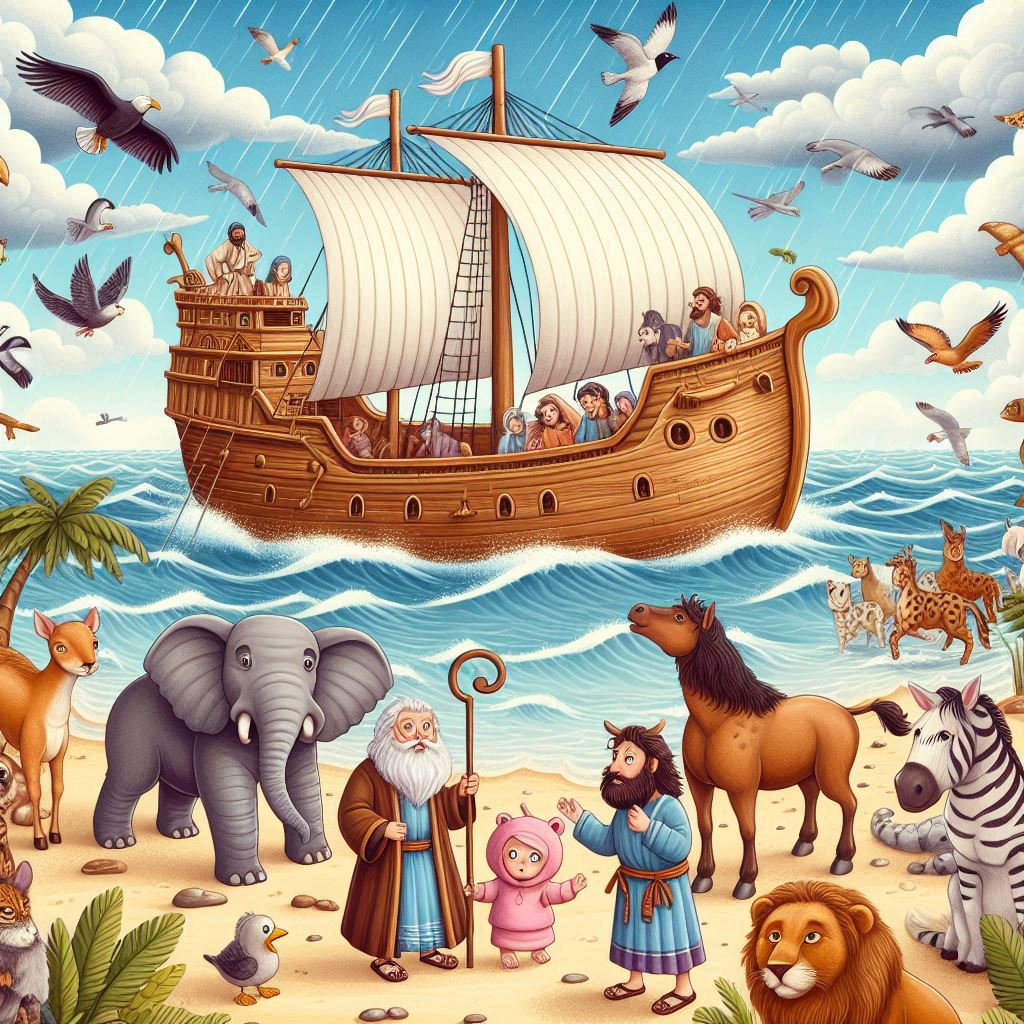
In Besorah al pi haDrash Matti 24:38-39, Yeshua HaTzaddik compares the time of the Son of Man's appearance to the days of Noach. According to the Jewish sages and Chassidic teachings, the time of Noach reflects profound lessons on spiritual complacency, ethical decay, and the call to awaken in anticipation of redemption. Jewish Yeshua’s warning in this passage echoes these themes and aligns with the messages of the sages regarding vigilance, self-reflection, and divine accountability.
1. Days of Noach and Spiritual Complacency:
- Eating, Drinking, and Marrying: The sages explain that in Noach’s generation, people were excessively focused on material pleasures and everyday life without concern for spiritual matters. This reflects a state of spiritual numbness where immediate desires mask the need for introspection and ethical action. Chassidic thought views these behaviors as emblematic of a self-centered lifestyle that ignores higher, divine purpose.
- Obliviousness to Consequences: The people in Noach’s time were oblivious to the impending flood, as they were too entangled in their own pursuits. In Kabbalistic interpretation, this represents a state of katnut mochin (constricted consciousness), where one is spiritually closed off from perceiving the consequences of their actions or recognizing the divine signals in life.
- Jewish Yeshua’s HaTzaadik parallel suggests that, similarly, many will be unaware and unprepared for the “flood” of spiritual transformation accompanying the Messianic era, which will cleanse and renew the world. The sages emphasize that the flood is not merely a punishment but a tikkun (repair), resetting humanity to align with divine will.
2.Ethical Decay and the Necessity of Tikkun (Repair):
- Moral Decline: The Talmud and Midrash describe Noach’s generation as morally corrupt, engaging in theft, violence, and forbidden relationships. This decline required divine intervention to cleanse the world, suggesting that unchecked moral decay necessitates renewal. According to Chassidut, each individual bears responsibility to uphold moral standards and avoid becoming “flooded” by egoistic desires.
- Symbol of the Ark as Torah and Prayer: The sages view the Ark as a symbol of Torah study and prayer—safe havens from moral and spiritual decay. In Chassidic thought, the Ark represents a protected state where one can maintain focus on divine service. Jewish Yeshua’s HaTzaddik message, by alluding to the Ark, encourages turning toward spiritual practices that align with God’s will, preparing one's “inner Ark” to withstand the trials of a world in chaos.
- This theme of building an “inner Ark” aligns with Jewish Yeshua's HaTzaddik call to be spiritually ready, interpreting the Ark as a symbol of preparation for redemption through Torah, mitzvot, and sincere prayer.
3.Awareness of Redemption and the Call to Awaken:
- Comparison to Mashiach: Jewish Yeshua’s reference to Noach’s time draws on the prophetic warnings in Judaism about the Messianic era, where people are urged to remain vigilant. The sages write that the days before Mashiach will be marked by confusion and a lack of clear spiritual leadership, paralleling the lost state of Noach’s generation. However, those attuned to divine purpose will be prepared.
- Divine Compassion and Judgment: Chassidic teachings emphasize that God’s judgments are ultimately rooted in mercy, even if they come through apparent harshness, as seen with the flood. In this context, Jewish Yeshua’s warning underscores the compassion behind divine judgment, as it ultimately serves to bring about correction and redemption. The flood represents a cleansing process that washes away impurity, preparing the world for a new beginning, just as the Messianic era will do.
4. Kabbalistic Interpretation of the Flood as a Spiritual Purification:
- Water as a Symbol of Purification:In Kabbalah, water represents Chesed (loving-kindness), and the flood is seen as a manifestation of God’s compassion, though severe, purifying the world from corruption. Similarly, the Messianic arrival is often described as a time of spiritual “flooding” that will purify the world, revealing hidden divine light. Just as Noach’s generation was submerged by water, the world at the time of Mashiach will be “flooded” with divine knowledge (Isaiah 11:9).
- Tikkun Olam through Mashiach ben Yosef: The sages teach that Mashiach will bring a tikkun olam (repair of the world), much like Noach’s actions created a foundation for a renewed world. The Son of Man coming in the days like those of Noach reflects this purification and calls for heightened spiritual awareness.The sages, particularly in recent interpretations, see Mashiach ben Yosef as facilitating the practical means of rectification, which includes the use of technology and infrastructure for good purposes. Rabbi Yitzchak Ginsburgh emphasizes that Mashiach ben Yosef’s mission integrates technology into the process of tikkun olam, as technology can be a vessel for advancing humanity’s spiritual goals when used ethically. The idea is to create a world where material advancements serve spiritual needs and lead humanity toward God.
- According to the Vilna Gaon,, Mashiach ben Yosef’s role is to gather the exiles of Israel, reestablish the physical and national foundation of the Jewish people, and promote Torah values within the land and people of Israel.
In conclusion, Mashiach ben Yosef’s role in tikkun olam is essential for repairing the world spiritually, ethically, and materially, enabling a foundation for universal peace and divine unity. By gathering the exiles, promoting Torah values, enduring suffering, and laying the groundwork for global transformation, Mashiach ben Yosef becomes a “hidden light” in the redemptive process. The Jewish sages emphasize that this role is crucial for preparing humanity for the ultimate redemption, where Mashiach ben David will complete the journey, ushering in a world fully aligned with divine purpose.
In summary, Jewish Yeshua HaTzaddik’s message in Besorah al pi haDrash, Matti 24 Tikkun Brit Hadshah echoes the teachings of the Jewish sages regarding Noach’s generation and the responsibility to remain spiritually prepared, vigilant, and morally upright. By drawing a parallel to Noach’s time, Yeshua warns of the potential dangers of spiritual complacency and the need for a personal “Ark”—a life anchored in Torah and divine service—to endure and be uplifted in the coming transformation that heralds the Messianic age.
THE "DAYS OF NOACH" (NOAH) TO THE "DAYS OF MASHIACH" (MESSIAH)
The generation of the flood, or Dor HaMabul, serves as a profound study of how unchecked human sin and moral decay invite spiritual forces associated with impurity and corruption. Jewish sages discuss these sins as rooted in the yetzer hara (evil inclination) but also recognize how persistent indulgence in certain behaviors opens pathways to the kelipot (spiritual husks) and lower realms, often understood as the “demonic realm” within Jewish mystical thought. In the context of Besorah al pi haDrash, Matti 24:37,, "As it was in the days of Noah, so it will be at the coming of the Son of Man,". For in those days before the flood, they were eating and drinking, marrying and giving in marriage, until the day Noah entered the ark, we can see how certain sins repeat patterns that attract spiritual forces of destruction. Here is how the sages describe this process and its implications:
Insights from the Sages on the Generation of the Flood and the Demonic Connection
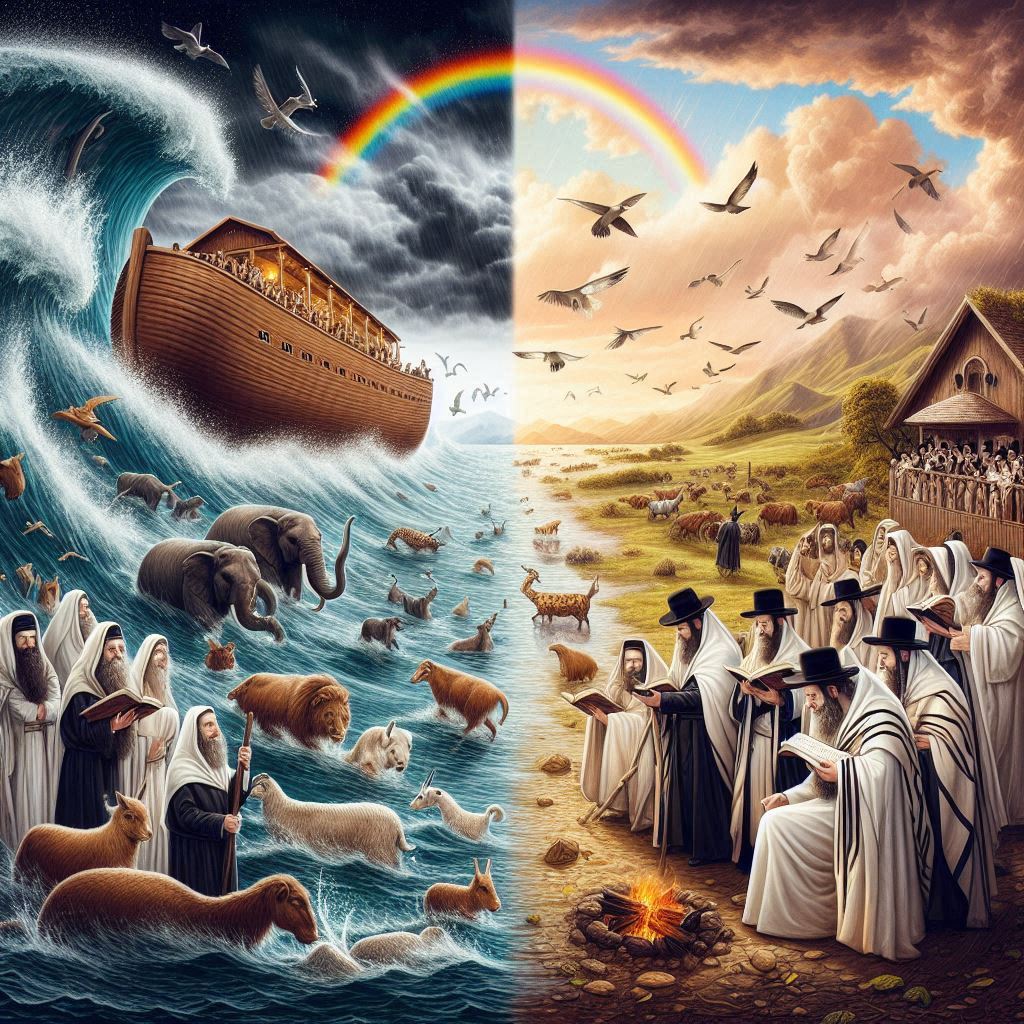
1.Corruption and Theft:
- The Talmud (Sanhedrin 108a) explains that while the people of Noach’s generation committed many transgressions, their decree of judgment was sealed because of chamas (corruption or theft). The sages state that when society becomes filled with theft, moral boundaries are eroded, creating an opening for kelipot to feed off the resulting chaos and selfishness, which are considered forms of idolatry.
2.Sexual Immorality and Breach of Covenant:
- The Zohar teaches that the generation of Noach fell deeply into arayot (sexual immorality), which is described as a primary gateway to the demonic forces. The sages elaborate that immoral acts not only pollute the soul but also create spiritual impurities that cling to a person, attracting the influence of destructive spiritual forces. The concept of Tikkun Brit (rectification of the covenant) is often emphasized to counteract this tendency, which the generation of Noach neglected entirely.
3.Worship of False Powers (Avodah Zarah):
- The Rambam (Maimonides) in Hilchot Avodah Zarah writes that idolatry or worship of false powers invites negative spiritual forces that oppose the divine will. While overt idolatry may not be as evident in Noach’s time, Midrashic sources suggest that people honored physical powers and nature above divine will, falling into forms of idolatry and thus inviting these negative forces into the world. The sages imply that reliance on materialism and power serves as a modern form of idolatry, echoing the state of society before the flood.
4.Violence and Bloodshed:
- In Pirkei d’Rabbi Eliezer, the sages note that violence and bloodshed were rampant before the flood, seen as acts that desecrate the sanctity of life and open the doors to spiritual destruction. In Midrash Tanchuma (Noach 10), it is mentioned that when people devalue life, they align themselves with forces of death, enabling demonic energies to grow stronger. The sages connect this with the end times, cautioning that society’s disregard for life mirrors the moral decline that led to the flood.
5.Desecration of Speech:
- Rabbi Yitzchak Ginsburgh explains that the generation of the flood fell into patterns of deceit and harmful speech (lashon hara), which the sages liken to the venom of a snake—symbolizing demonic influence. Speech holds creative power, and when it is used destructively, it brings forth negative forces into the world. This is seen as a hallmark of the demonic realm, which opposes the purity of divine speech and creative potential.
6.Pride and Hubris Against Divine Will:
- The Midrash Rabbah (Genesis 31:5) states that in their arrogance, the generation of Noach felt they could live without divine guidance, which the sages interpret as a form of rebellion associated with the forces of Sitra Achra (the “other side”). Rabbi Shimon bar Yochai teaches that this mindset of independence from the Creator attracts forces of chaos and separation, aligning humanity with realms that resist divine harmony.
7.Alignment with Demonic Energies Through Desire:
- The Arizal explains that unrestrained desire connects people with the lower spiritual realms,where passions and cravings are dominant. The generation of the flood pursued their desires without restraint, and as a result, they descended into alignment with realms that the sages describe as demonic. The soul’s ability to resist the yetzer hara’s pull was weakened, causing a descent that ultimately warranted divine intervention.
8.Absence of Chesed (Kindness):
- In Avot de-Rabbi Natan,it is taught that Noach’s generation failed to practice chesed (loving-kindness), a virtue that sustains creation. The absence of kindness weakened the fabric of human connection, giving strength to spiritual forces that thrive on division and selfishness. The sages warn that when humanity neglects kindness, it paves the way for demonic energies to spread.
Parallels to the End of Days
- In alignment with Besorah al pi haDrash, Matti 24:37, Jewish tradition describes that the era before Mashiach will echo the sins of Noach’s generation, leading to spiritual conditions that mirror those earlier times. However, the sages also stress the availability of Tikkun (rectification), which involves returning to covenantal values, practicing kindness, and honoring the sanctity of life and speech. The parallels are not just in actions but in the underlying spiritual realities: a world that opens itself to impurity requires divine judgment, which is ultimately aimed at tikkun and bringing humanity back to spiritual alignment.
- The teachings of the sages encourage vigilance against these influences by adhering to Torah principles, promoting chesed, and focusing on the sanctity of the covenant, which protects against demonic forces. Through this preparation, humanity can align itself with divine mercy and engage in a redemptive process, rather than inviting judgment, as was seen in the days of Noach.
Summary
- The Jewish sages draw parallels between the days of Noach and the days of Mashiach to emphasize themes of renewal, divine justice, moral reformation, and the ultimate restoration of order and peace. These concepts are woven into various texts and teachings within Jewish tradition, underscoring a vision of a transformed world aligned with divine will.
- In Chassidut and Kabbalistic teachings, the comparison between the "days of Noah" and the "days of Mashiach" is rich with mystical and esoteric insights. These teachings explore deeper spiritual and cosmic dimensions of these periods, emphasizing not just the surface-level moral and societal changes but also profound spiritual transformations. Here’s a more detailed exploration from Chassidut and Kabbalistic perspectives:
- In Jewish tradition, the era before Mashiach is likewise described as being rife with theft and economic corruption. The Talmud (Sanhedrin 97a) describes how business dealings will be filled with deceit, and people will "steal from one another without shame," similar to the behavior of Noah's generation.
The Flood Generation and the Final Generation
- The Midrash (Genesis Rabbah 28:6) draws direct comparisons between the generation of Noah and the final generation before the Messianic era. Both generations are characterized by widespread moral corruption, breakdowns in justice, and a world filled with violence and depravity. In Jewish eschatology, these patterns of sin — idolatry, murder, sorcery, sexual corruption, and theft — will re-emerge before the ultimate redemption, just as they did before the flood.
- In particular, the Zohar (1:119a) notes that the final generation will face intense spiritual trials, as the forces of impurity will seek to dominate the world before being vanquished by the arrival of the Mashiach. The flood generation represents a period where unchecked human sin and demonic forces brought the world to destruction, while the Messianic generation will witness a final battle between good and evil before the ultimate redemption.
- The concept of comparing the "days of Noach" (Noah) to the "days of Mashiach" (Messiah) is rooted in Jewish tradition and rabbinic literature. The comparison is often used to draw lessons and highlight the expected conditions and transformations that will occur in the Messianic era. Here’s how this comparison is discussed in Jewish sources without relying on Esav principles:
Days of Noach vs. Days of Mashiach-Key Similarities:
1.Corruption and Morality:
- Days of Noach: The world was marked by moral and ethical corruption, leading to the divine decision to bring the Flood as a form of divine judgment (Genesis 6:5-13).
- Days of Mashiach: Similar themes are anticipated in the Messianic era, where there will be significant moral decay. Rabbinic sources indicate that before the coming of Mashiach, there will be a time of great upheaval and moral degradation (e.g., Talmud, Sanhedrin 97a; Zohar, Parashat Pinchas 229b).
2.Rebirth and Transformation:
- Days of Noach: After the Flood, the world was cleansed and renewed. Noah and his family were tasked with repopulating and renewing humanity (Genesis 9:1).
- Days of Mashiach: The Messianic era is described as a time of renewal and transformation for the world. The world will undergo a process of purification and will experience a significant transformation, leading to a time of peace and divine presence (e.g., Isaiah 2:2-4; Maimonides, Mishneh Torah, Laws of Kings 12:1).
3.Divine Presence and Covenant:
- Days of Noach: After the Flood, God made a covenant with Noah and all living creatures, symbolized by the rainbow (Genesis 9:12-17).
- Days of Mashiach: The Messianic era is associated with a renewed and enhanced relationship between God and humanity. This includes the fulfillment of the covenantal promises made to the Jewish people and the establishment of divine sovereignty (e.g., Ezekiel 37:26-28; Rambam, Mishneh Torah, Laws of Kings 12:5).
4.Peace and Security:
- Days of Noach: The Flood brought an end to the chaos and violence of the pre-Flood world. After the Flood, a new era of peace was envisioned (Genesis 8:11).
- Days of Mashiach: The Messianic era is often described as a time of universal peace and security, where conflicts will be resolved, and harmony will prevail (e.g., Micah 4:3; Talmud, Berakhot 12b).
5.Humanity’s Role:
- Days of Noach: Noah is portrayed as a righteous individual who preserves humanity through the Flood and is a model of righteousness (Genesis 6:9).
- Days of Mashiach: The Jewish tradition holds that humanity, particularly the Jewish people, has a crucial role in preparing for and establishing the Messianic age. This includes adherence to divine commandments and ethical conduct (e.g., Maimonides, Mishneh Torah, Laws of Kings 12:1).
6.Role of Righteous Individuals:
- Days of Noach: Noah is portrayed as a righteous individual in a corrupt generation. His righteousness and adherence to God's commands were pivotal in ensuring the survival of humanity and the renewal of the world (Genesis 6:9).
- Days of Mashiach: The Jewish tradition emphasizes the role of righteous individuals and leaders in preparing for and ushering in the Messianic age. The actions and conduct of such individuals are seen as instrumental in shaping the redemption and ensuring that it aligns with divine will (Maimonides, Mishneh Torah, Laws of Kings 12:2).
- INSIGHT CHADDISUT TEACHINGS- the comparison between the "days of Noah" and the "days of Mashiach
- The Jewish sages draw parallels between the days of Noach and the days of Mashiach to emphasize themes of renewal, divine justice, moral reformation, and the ultimate restoration of order and peace. These concepts are woven into various texts and teachings within Jewish tradition, underscoring a vision of a transformed world aligned with divine will.
- In Chassidut and Kabbalistic teachings, the comparison between the "days of Noah" and the "days of Mashiach" is rich with mystical and esoteric insights. These teachings explore deeper spiritual and cosmic dimensions of these periods, emphasizing not just the surface-level moral and societal changes but also profound spiritual transformations. Here’s a more detailed exploration from Chassidut and Kabbalistic perspectives:
The Flood Generation and the Final Generation
- The Midrash (Genesis Rabbah 28:6) draws direct comparisons between the generation of Noah and the final generation before the Messianic era. Both generations are characterized by widespread moral corruption, breakdowns in justice, and a world filled with violence and depravity. In Jewish eschatology, these patterns of sin — idolatry, murder, sorcery, sexual corruption, and theft — will re-emerge before the ultimate redemption, just as they did before the flood.
- In particular, the Zohar (1:119a) notes that the final generation will face intense spiritual trials, as the forces of impurity will seek to dominate the world before being vanquished by the arrival of the Mashiach. The flood generation represents a period where unchecked human sin and demonic forces brought the world to destruction, while the Messianic generation will witness a final battle between good and evil before the ultimate redemption.
- The concept of comparing the "days of Noach" (Noah) to the "days of Mashiach" (Messiah) is rooted in Jewish tradition and rabbinic literature. The comparison is often used to draw lessons and highlight the expected conditions and transformations that will occur in the Messianic era. Here’s how this comparison is discussed in Jewish sources without relying on Esav principles:
1.Spiritual Corruption and Cosmic Repair:
- Days of Noach-Spiritual Decline: In Kabbalistic thought, the moral corruption of Noah’s time is seen as a reflection of deeper spiritual distortions. The generation before the Flood is understood to have caused cosmic imbalance, disrupting the divine harmony of creation. The proliferation of sin and violence had far-reaching implications on the spiritual realms, not just on the physical world (Zohar, Parashat Noach 59a).
- Days of Noach-Tikkun (Repair): The Flood serves as a form of cosmic purification, intended to restore balance and rectify the spiritual damage caused by the previous generation’s actions. Noah’s survival and the subsequent renewal of the world symbolize the process of Tikkun, or spiritual repair, that was needed to reestablish divine order (Chassidut, Likutei Torah, Parashat Noach).
- Days of Mashiach-Messianic Tikkun: The Messianic era is viewed as a time of ultimate Tikkun, where the entire world will undergo a profound spiritual rectification. This era will correct the cosmic and spiritual flaws that have accumulated over time. It is seen as the culmination of the ongoing process of Tikkun that began with Noah and continued throughout history (Zohar, Parashat Pinchas 230b; Tanya, Iggeret HaKodesh, Epistle 24).
2.Divine Presence and the Revelation of the Infinite Light:
- Days of Noach-Limited Divine Presence: Before the Flood, the divine presence (Shechinah) was somewhat hidden due to the pervasive corruption and spiritual disarray. The Flood represented a moment when the Shechinah was temporarily concealed, leading to a dramatic and transformative event to reestablish divine order (Zohar, Parashat Noach 62b).
- Days of Mashiach-Revelation of the Infinite Light: The Messianic age is associated with a revealed and profound presence of the divine light (Or Ein Sof). According to Kabbalistic teachings, Mashiach will bring about a revelation of the Infinite Light that will illuminate and uplift the entire world. This era will be characterized by an open and manifest divine presence that transcends the concealed nature of divine interaction in previous eras (Zohar, Parashat Bereshit 7a; Chassidut, Likutei Sichot, Vol. 7).
3.The Role of Righteous Individuals and Spiritual Leadership:
- Days of Noach-Noah’s Role: Noah is seen as a pivotal figure whose righteousness was crucial for the survival of creation. In Kabbalistic terms, Noah represents a channel through which divine mercy and protection were channeled to preserve the potential for spiritual renewal (Zohar, Parashat Noach 59a).
- Days of Mashiach-Role of Mashiach: The figure of Mashiach is viewed as a transformative leader who will channel divine light and bring about the ultimate spiritual rectification. The Messiah will serve as a conduit for the revelation of higher spiritual truths and will guide humanity toward the final Tikkun. This role includes restoring the divine order and elevating the collective consciousness of the world (Chassidut, Tanya, Chapter 37; Maimonides, Mishneh Torah, Laws of Kings 12:4).
4.The Nature of Time and Redemption:
- Days of Noach-Time of Transition: The period of Noah is seen as a transitional phase in the cosmic cycle, a time when the world underwent significant upheaval in preparation for a new phase of divine purpose. The Flood represents a dramatic shift from one era to another, preparing the ground for a renewed spiritual beginning (Zohar, Parashat Noach 61b).
- Days of Mashiach-Epoch of Completion: The Messianic era is anticipated as the culmination of all previous epochs. It is the final stage of a long process of spiritual evolution and redemption, where time itself will reach its ultimate fulfillment. This era will not only correct the spiritual flaws of earlier periods but will also bring about a complete and perfect revelation of divine truth (Chassidut, Likutei Torah, Parashat Behar; Zohar, Parashat Pinchas 232a).
5.The Influence of Human Actions:
- Days of Noach-Human Influence on Divine Plan: The actions of humanity in Noah’s time significantly influenced the course of divine judgment and redemption. The moral and spiritual choices of individuals had a profound impact on the cosmic order, leading to the necessity of the Flood as a corrective measure (Zohar, Parashat Noach 59a).
- Days of Mashiach-Impact of Righteous Actions: In the lead-up to the Messianic age, the actions of individuals, particularly those who embody righteousness and spiritual insight, are believed to play a crucial role in accelerating the arrival of Mashiach. The collective efforts of individuals to live according to divine principles are seen as essential in bringing about the final redemption (Chassidut, Tanya, Chapter 36; Maimonides, Mishneh Torah, Laws of Kings 12:5).
Summary: In Chassidut and Kabbalistic thought, the comparison between the days of Noah and the days of Mashiach reveals profound spiritual insights. The pre-Flood era is seen as a time of cosmic imbalance and moral decay requiring purification and renewal. The Messianic era is anticipated as a time of ultimate spiritual rectification, revelation of divine light, and cosmic harmony. Both periods are characterized by transformative events that reflect deeper spiritual processes and divine intentions, emphasizing the role of human actions in shaping the course of divine redemption.
BEIT YISRAEL INTERNATIONAL
Bet Yisrael International From Gaddi
Many Blessings to all the ShneymAsarHaShevatim (Twelve Tribes) in the Golus, Shalom!!!